As cities continue to grow, one of the biggest challenges is ensuring they remain livable, sustainable, and well-organized. From reducing traffic congestion and creating green spaces to planning public transport systems and affordable housing, urban planning plays a vital role in shaping the way we live.
This is where Architecture (Urban Planning) comes in. While architects focus on designing individual buildings and structures, urban planners look at the bigger picture—planning entire neighborhoods, towns, and cities to make them functional, efficient, and environmentally sustainable.
If you're passionate about architecture, design, geography, sustainability, and solving real-world problems, Urban Planning offers an exciting career that blends creativity with strategic thinking.
What is Urban Planning?
Urban Planning is the process of designing and managing the development of cities, towns, and communities. It involves deciding how land should be used, where roads and public transport should be built, how housing should be developed, and how cities can grow while protecting the environment and improving the quality of life for residents.
Urban planners work closely with architects, civil engineers, environmental scientists, government authorities, and policymakers to create cities that are safe, accessible, and future-ready.
As India's urban population continues to grow rapidly, the demand for professionals who can plan sustainable infrastructure and smart cities is increasing every year.

What Does an Urban Planner Do?
Urban planners are responsible for creating development plans that balance economic growth, environmental protection, and community needs. Their work often includes:
- Designing city master plans
- Planning transportation and metro networks
- Developing residential and commercial zones
- Conducting land-use surveys
- Improving public infrastructure
- Planning parks and green spaces
- Managing sustainable urban development projects
- Studying population growth and future infrastructure needs
- Advising governments on city planning policies
- Assessing environmental and social impacts of development projects
Unlike architects who primarily focus on individual buildings, urban planners think about how entire communities function together.
Career Pathway
Students interested in Urban Planning usually begin with Architecture or Planning-related courses after Class 12.
A common pathway is:
Some professionals also pursue postgraduate degrees in:
- Urban and Regional Planning
- Transportation Planning
- Environmental Planning
- Infrastructure Planning
- Housing and Urban Development
- Smart City Planning
- GIS and Remote Sensing
A master's degree can help students specialize in a particular area and improve career prospects.
Popular Courses
Some of the most sought-after courses include:
- Bachelor of Planning (B.Plan)
- Bachelor of Architecture (B.Arch)
- M.Plan (Urban Planning)
- M.Plan (Transport Planning)
- M.Plan (Environmental Planning)
- M.Plan (Housing)
- M.Plan (Infrastructure Planning)
Students interested in city development often choose B.Plan directly, while architecture graduates may later specialize in urban planning through postgraduate studies.
Top Colleges in India
Some of India's leading institutions offering Architecture and Urban Planning programs include:
- School of Planning and Architecture (SPA), Delhi
- SPA Bhopal
- SPA Vijayawada
- CEPT University, Ahmedabad
- IIT Kharagpur
- NIT Calicut
- Jamia Millia Islamia
- Chandigarh College of Architecture
- Anna University
- Lovely Professional University (LPU)
These institutions are well-known for their strong academic programs, industry collaborations, and practical exposure.
Entrance Exams
Admission varies depending on the course and institution. Common entrance examinations include:
- NATA (National Aptitude Test in Architecture) — for B.Arch admissions in many colleges
- JEE Main Paper 2A (B.Arch) — accepted by several institutions, including some NITs and SPAs
- JEE Main Paper 2B (B.Plan) — specifically for Bachelor of Planning programs
- CUET-UG — accepted by some universities for planning-related courses
- University-specific entrance examinations or merit-based admissions
Students should always check the admission criteria of individual institutions before applying.
Salary Range in India
Salary depends on qualifications, experience, employer, and specialization. Typical salary ranges are:
- Entry-Level Urban Planner — ₹4–7 LPA
- Planning Consultant — ₹6–10 LPA
- GIS & Spatial Planning Specialist — ₹6–12 LPA
- Urban Design Professional — ₹8–15 LPA
- Senior Urban Planning Consultant / Project Manager — ₹15–30+ LPA
Professionals working with international consulting firms, smart city projects, infrastructure companies, or global development organizations often earn significantly higher salaries.
Career Roles
Urban Planning offers diverse career opportunities across the public and private sectors, including:
- Urban Planner
- Town Planner
- Regional Planner
- Smart City Consultant
- Urban Designer
- Transportation Planner
- Infrastructure Planning Consultant
- Housing Policy Analyst
- GIS Specialist
- Land Use Planner
- Environmental Planner
- Development Authority Officer
- Planning Researcher
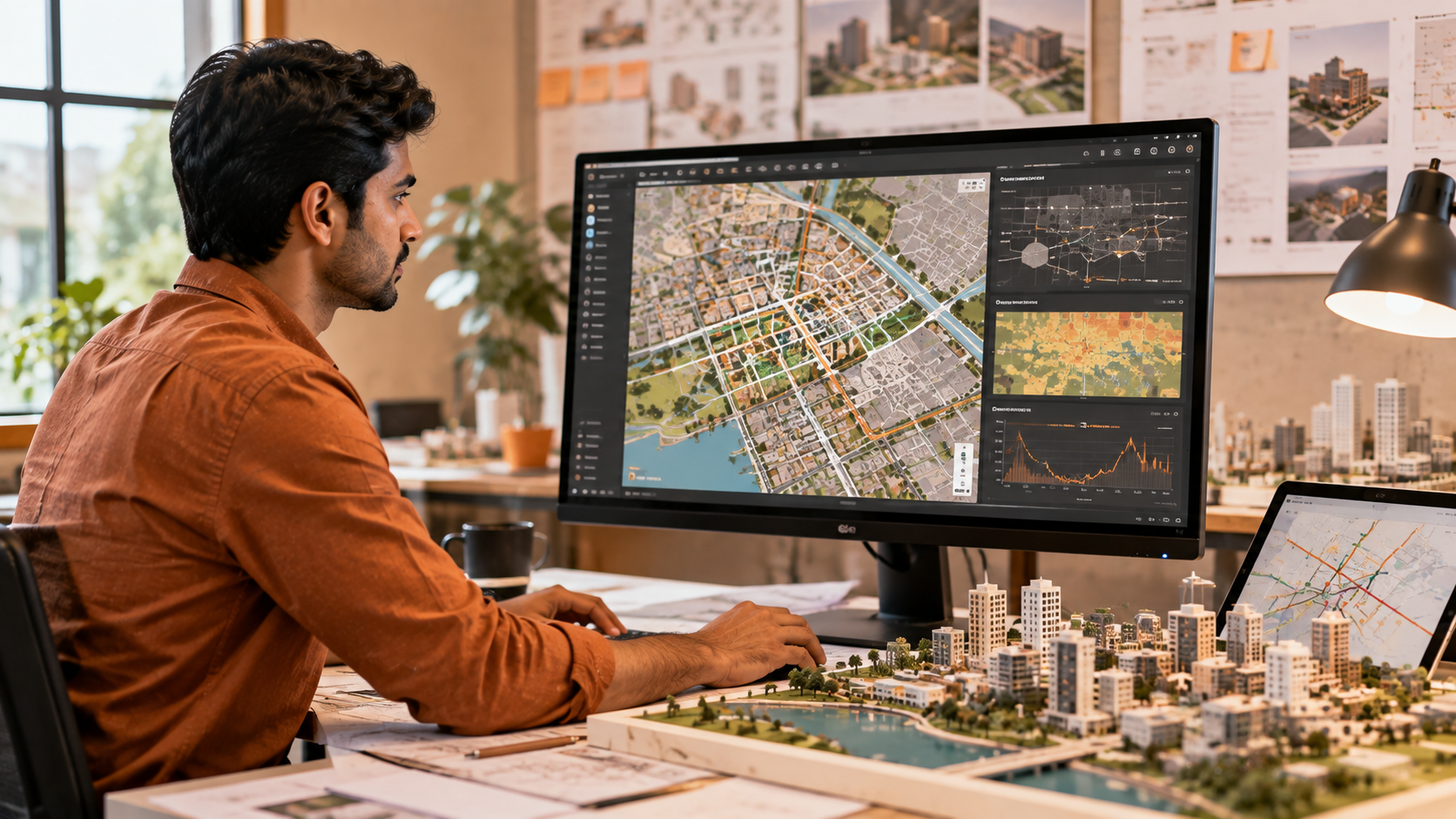
Professionals may work with government agencies, municipal corporations, consulting firms, real estate developers, infrastructure companies, NGOs, or international organizations.
Skills Required
Urban Planning combines technical expertise with creative thinking. Successful professionals usually possess:
- Strong analytical and problem-solving skills
- Creativity and design thinking
- Knowledge of geography and urban development
- Understanding of sustainability principles
- Communication and presentation skills
- Data interpretation and research abilities
- Teamwork and collaboration
- GIS and mapping software knowledge
- Basic understanding of architecture and civil engineering
- Project management skills
Professionals often use tools such as AutoCAD, ArcGIS, QGIS, SketchUp, Revit, and GIS-based planning software to prepare plans and analyze urban data.
Future Scope
Urban Planning is becoming one of the most important professions in the coming decades. As India's cities expand and new infrastructure projects emerge, there is a growing need for experts who can create sustainable, inclusive, and efficient urban environments.
Government initiatives such as the Smart Cities Mission, metro rail expansion, affordable housing programs, industrial corridors, and sustainable infrastructure projects are creating new opportunities for urban planners. At the same time, private developers, consulting firms, and international organizations are increasingly hiring professionals who can address challenges related to climate resilience, mobility, housing, and resource management.
Emerging fields like smart city development, digital urban twins, climate-resilient planning, green infrastructure, and data-driven urban analytics are expected to shape the future of the profession.
Is Urban Planning the Right Career for You?
This career could be an excellent choice if you:
- Enjoy architecture, geography, and design
- Like solving large-scale real-world problems
- Are interested in sustainable development
- Want to improve how cities function
- Enjoy working with technology, maps, and data
- Prefer combining creativity with analytical thinking
However, if you are looking only for artistic building design, a career focused purely on architecture may be more suitable than urban planning.
Final Thoughts
Urban Planning is about much more than designing roads or buildings—it's about creating cities where people can live, work, travel, and thrive. As populations grow and urban challenges become more complex, skilled planners will play a key role in shaping resilient, sustainable, and future-ready communities.
For students who want to combine design, technology, sustainability, and public impact, Architecture (Urban Planning) offers a rewarding career with diverse opportunities in government, consulting, infrastructure, and global development. If you aspire to leave a lasting mark on the cities of tomorrow, Urban Planning could be the perfect career path for you.